




By Jorge Casuso
November 2, 2026 – A leading animal rights group last week joined a call for City officials to remove the deteriorating bird-deterrent netting that is killing pigeons under the Santa Monica Pier.
The netting, which was last replaced three years ago, is meant to deter pigeons from nesting and eliminate the pigeon droppings that contribute to unhealthy levels of bacteria that for years have made the waters around the Pier the most polluted on the West Coast.
 |
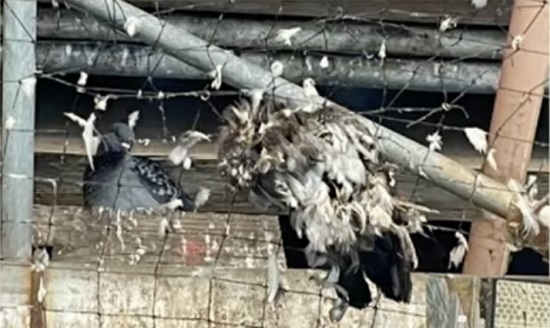
People for the Ethical Treatment of Animals (PETA) informed supporters that it recently received a report that "birds have become trapped behind the netting and died on multiple occasions," the non-profit group wrote on its Facebook page.
"While the desire for nonlethal bird control is admirable, reports of improperly installed or broken netting are far too common, so these devices frequently do more harm than good," the group wrote.
 |
| Photo by Sierra Glassman |
"We’re told pier management was first alerted to this issue a year ago and that they’ve claimed to be working on a solution ever since. PETA received a similar response from officials, yet conditions remain unchanged."
The issue resurfaced at the October 13 City Council meeting in comments made by Sierra Glassman, a National Science Foundation Graduate Research Fellow and a second-year graduate student in the UCLA Ecology & Evolutionary Biology program.
During public comment, Glassman, who studies bird ecology and evolution, made a power-point presentation that included images of dead pigeons snarled in the net's webbing.
"The last time I counted," she told the Council, "there's at least 20.dead. Netting is a very cruel way for an animal to die.
"They can hang there for hours, maybe days, and they're just hanging there as they starve and dehydrate to death," Glassman said.
The surface of the net, she added, "is expanding the surface area on which the pigeons can breed. I saw them nesting directly on top of the net. It's increasing the number of pigeons under the Pier."
City officials, Glassman said, acknowledge the problem needs to be addressed, but have provided no timeline or confirmation that the netting will be removed.
The netting was first installed in 2009 to address the persistently high levels of bacteria that have made the waters around the Pier the second most polluted beach on the West Coast, topped only by Mexico's Playa Blanca, a beach contaminated by untreated sewage from the Tijuana region.
The City last replaced the netting in August 2023. A Facebook post at the time from Bird Masters LA. Inc, the company hired by the City, said, "It took us 5 months to install 110,000 thousand square feet of netting under the Santa Monica pier. We’re the leaders in effective, humane bird control."
In a blog post shortly after the installation was completed, the City's Water Resource Manager, Sunny Wang, said the netting would "ensure the well-being of the birds while minimizing their impact on beach water quality, both of which are important to the preservation and maintenance of the Santa Monica Pier."
Three months after the netting went up, the Council in November 2023 took the additional step of banning the feeding of birds near the pier.
"Studies have indicated that high bacterial readings in the ocean just south of Santa Monica Pier could be primarily related to pigeon droppings," staff wrote in a report to the Council.
"Pigeons are attracted to the Pier because it provides both a roosting structure and access to food," staff said. "The City recently installed new bird netting under the Pier to limit bird roosting. However, the birds may still congregate in the area because of the available food sources."
Despite the new netting and feeding ban, the water around the Pier remained the most polluted stretch of beach on the West Coast outside of Tijuana, earning an unusual rebuke from Heal the Bay in its 2024-2025 Beach Report.
The City, the report stated, "has invested millions to address the problem, including upgrades to stormwater capture systems and bird deterrent netting.
"But inconsistent maintenance of the netting and urban runoff from the Pier remains a challenge," the report said. "The limited effectiveness of current measures highlights the need for increased mediation."